
Accounting in Chile: What Nobody Tells You (And the Mistakes That Cost You)

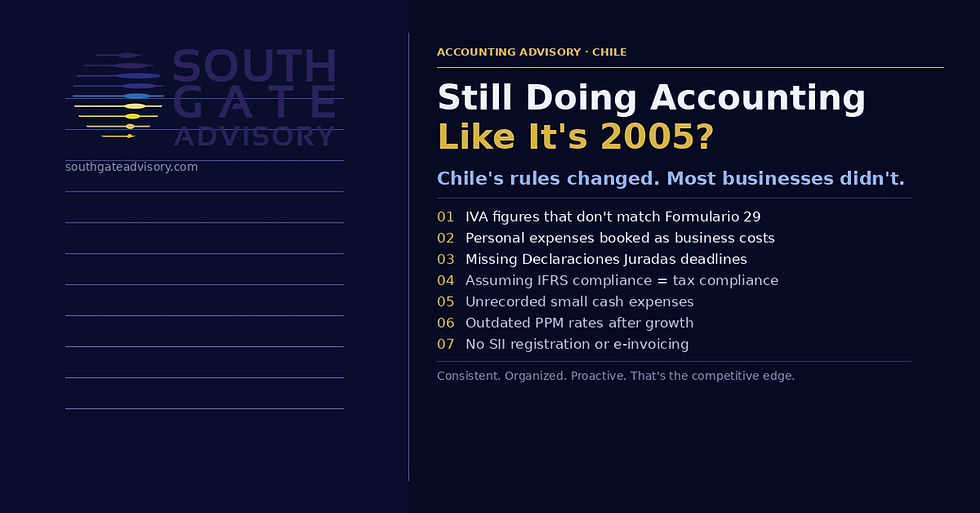
Chile's accounting landscape changed forever, but most businesses are still operating like it's 2005. Here's a no-nonsense breakdown of what's going on, and where the painful, avoidable errors keep happening.
The system has two personalities, and most people only manage one.
In Chile, accounting has two distinct dimensions that must coexist: tax accounting, governed by the requirements of the Servicio de Impuestos Internos (SII), and financial accounting, also known as general accounting, which follows international IFRS standards and presents the real picture of your business's health. The biggest mistake companies make is treating them as the same thing—they are not.
When the two frameworks diverge—and they do, on things like asset valuation, revenue recognition, and depreciation—you need to make explicit adjustments to reconcile the financial result with your taxable result. When those adjustments don't happen, the SII notices.
A timeline few read carefully
Chile's IFRS adoption was gradual and, for many businesses, invisible until it wasn't. The process began in 2004, with full implementation for large companies in 2010. By 2012, companies with annual gross revenues above 300,000 UF were required to apply the standards. Then, in 2013, the Colegio de Contadores de Chile revoked all previous local accounting norms and formally adopted IFRS as the framework.
The change that caught many off guard came on January 1, 2024: the threshold dropped to 100,000 UF in annual revenue, pulling a significantly larger universe of companies into mandatory IFRS territory. Many found out late. Some are still catching up.
"IFRS is fine as long as it doesn't get in the way."
That's not a quote from a rebellious CFO. That's essentially the SII's own position. In multiple official communications, the tax authority has clarified that while IFRS-based accounting is acceptable, it is valid for tax purposes only to the extent that it allows proper fulfillment of tax obligations and facilitates oversight. Adopting IFRS does not automatically make your books "fidedignos” the legal standard of reliable, auditable accounting. That construction is a hybrid of what the SII demands and what your business actually needs.
The 7 common mistakes that cost Chilean companies the most
1. IVA figures that don't match Formulario 29
The SII automatically cross-references the IVA credit and debit amounts in your Registro de Compras y Ventas against what was declared. When the numbers don't align with what your suppliers or clients reported, the system flags it immediately, triggering an automatic observation or a full audit. The fix sounds simple: your Form 29 must be an exact mirror of your RCV. In practice, this requires real-time reconciliation, not a last-minute check the day before filing.
2. Personal expenses dressed up as business costs
Registering expenses that have no direct relationship to your company's line of business is one of the most common and risky errors in Chile. Grocery receipts, personal lunches, and family celebrations—the SII knows this happens and actively seeks it out. If an expense appears under your company's RUT and can't be justified as related to the company's business nature, you're exposed to mandatory corrections, interest charges, and fines. The rule is simple: if the purchase is personal, request a boleta for yourself, not an invoice for the company.
3. Missing Declaraciones Juradas deadlines
The Formulario 22 gets all the attention, but it's far from the only document with a hard deadline. Declaraciones Juradas covering withholdings, digital assets, leasing contracts, and other specific transactions have their own independent filing dates. Miss one and the SII marks your Form 22 with observations and applies automatic fines, no warning, no grace period. In 2026, not filing your income tax declaration on time can cost up to $340,000 CLP in penalties alone.
4. Confusing financial accounting with tax accounting
Many businesses assume that presenting IFRS-compliant financial statements means they have automatically satisfied the SII. They haven't. The two systems have coexisted with divergences since long before IFRS arrived—what used to be called temporary and permanent differences under the old PCGA framework still exist under IFRS. The financial result must be adjusted to arrive at the taxable result. When those adjustments are missing or poorly documented, the company is sitting on a time bomb.
5. Unrecorded small cash expenses
Transportation, per diems, and small cash purchases tend to be logged "later" or simply forgotten. The result is a set of books that systematically overestimates actual profitability, distorts business decisions, and can raise questions during an audit when the numbers don't add up. The discipline of recording every expense at the moment it happens isn't bureaucracy—it’s the difference between knowing how your business is actually performing and guessing.
6. PPM rates that haven't kept up with growth
Monthly provisional Corporate Income Tax payments (PPM) are calculated based on the company's revenues. If the business grew significantly but the rate wasn't updated to reflect that, the gap that appears during the Operación Renta can be painful and expensive. This is a slow-motion mistake; it accumulates quietly and reveals itself in April, when there's little room to maneuver.
7. Not registering with the SII or not issuing electronic invoices
Operating without registration can result in fines of 1 to 3 UTM, as well as a potential temporary closure of operations. Failing to issue electronic invoices, which are mandatory for all companies in Chile, regardless of size, carries sanctions of between 10% and 50% of the transaction value under Article 97 N° 10 of the Tax Code. Repeated violations result in cumulative fines.
What to do starting today
You don't need a PhD in IFRS or tax law. You need three things: accounting software that keeps pace with regulatory changes, an accountant who genuinely manages both the financial and tax dimensions in parallel, and a compliance calendar that doesn't get assembled in a panic every March.
The SII can conduct audits covering up to 2 years of activity, and, in cases where false information is detected, the window extends to 6 years. During an active audit, your company operates in a kind of limbo where major decisions carry real risk. Preventing that situation is incomparably cheaper than surviving it.
The businesses that handle Chilean accounting well aren't doing anything exotic. They're consistent, organized, and honest with their numbers. That's still the disruptive move.


Comments